Monday, 30 June 2014

How to Use a Blog as the Cornerstone of Your Content Marketing

How to Use a Blog as the Cornerstone of Your Content Marketing

Content Marketing seems to be the buzzword thrown around a lot by businesses today. Everywhere you turn, experts state that you must use content to build your brand.
Well, that is great and all, but how do you actually accomplish this mighty goal with the blog as the cornerstone of your content marketing?
That is where this post comes in. We want to tell you how to implement a content marketing strategy with your blog that can make an impact in your business.

Top to bottom content marketing

Content marketing doesn’t start with content… it needs a plan.

1. Have a strategy

One of the biggest challenges most content marketers have is that they just start creating content.
That does not work. You must understand the value of the content you are creating. Every piece of content should be getting your business closer to your stated goals.
For example, if you created a blog and your aim is to add one client per month, then you need to determine how many blog posts you need to post per month to achieve this goal.
An easy way to do this is to work backwards. What percentage of your prospects become clients? Next, determine how many leads or email subscriptions you receive from each blog post.
Based on those numbers you can then set your target blog post count per month. As time goes by you can adjust the numbers to match your conversion rates or to increase the number of clients obtained.
Take the idea above of adding one new client per month. If your close ratio is 1 out of 10, then you need your blog to produce 10 leads per month. If each post produces three leads, then you will need at least one post per month to succeed.

2.  Find out what your clients want

Have you ever written a blog post that you thought was just brilliant? Seriously, if it was any better, you would think that it was divinely inspired.
Then you proudly share your work, only to receive a lackluster response. What happened? Likely you wrote your blog post for yourself and not your audience. 
Writing a blog post is different than writing a journal or diary entry. In the later, you get to muse, note down your personal thoughts and observations, as well as dwell on whatever topic takes your fancy.
In a blog post, you need to remember that interaction is the name of the game. This means, you should ask your clients, readers, and prospects what they want to hear about on your blog. Use polling software like Survey Monkey or Gravity Forms to find out what your readers want you to talk about on the blog.
Then you will not have to guess what to discuss. You will know what information your audience craves.

3. Be a resource

You are not blogging to make money. You are blogging to be a resource to your clients and prospects. This means helping them whenever possible.
By providing information on your blog you offer added value to your prospects. This is something they will remember when they need your services.
Creating value can mean anything from providing them with the information they need (education), entertainment, free giveaways, or inspiration. As mentioned in the previous point, find out what your readers want and then deliver on that need.
Some sites like Buzzfeed deliver value by creating interesting lists of memes. Many an hour is wasted reading 15 Game of Thrones Pickup Lines, Cats Who Look Better with Bangs, and other “needed” topics of discussion.
On another note, writing a blog post about content marketing tips could be very valuable to bloggers. (Deep thoughts!)

4. Marketing is 80% of content marketing

Once a blog post is published, the real work begins. While this is the point where most authors think they are done, the truth is that marketing should be 80% of the work you do on a blog post. That way, it has the chance to get the widest possible audience.
How do you market your content then?
First, this is where your social network plays a big part. If you are consistently adding targeted connections to your social networks, you will find that those people will be your target market and the most likely to check out your blog posts.
Have accounts set up on the major social networks. Then make sure to post your content at regular intervals on the social networks relevant to your business. Linked, Google+, and Facebook all have amazing groups where you can begin to develop a rapport with other members. Just remember that if you only post your own content in the group, you will be quickly ignored.  In fact, 80% of your contributions should not be about your own content, but a mixture of information, sharing, and communicating with others.
Furthermore, once you have published content, remember to let your email list know. That way, instead of only sending them offers, you are providing them with valuable information they can use.
Sponsored Ads are another option to promote your content. You can use paid search to help you garner targeted visitors to your content. This works really well with Facebook and Twitter sponsored posts, as well as Google and Bing Pay Per Click ads.

5. Connect with influencers

Since blogging is about gaining influence, you have to accept the fact that in today’s market someone will generally be a stronger blogger in your field than you are. That is OK, because you get the chance to connect with them to see how you can create a mutually beneficial relationship.
Start connecting with influencers in your field. You will be surprised how big a role they will play in your business over the years. People you meet at conferences, can become business partners, or joint venture partners promoting your products.
In today’s fluid online business environment, there are no true competitors. Those people who might be your competitors might well be the ones most likely to share your content to their social network.
This means you need to spend time developing relationships with influencers in your industry. If you are afraid of competitors, then find synergistic partners you can have a mutually beneficial relationship.

Putting together a campaign

Now that you have steps needed to create a great campaign, it is time to take action. Content marketing takes time to work successfully, so do not start a campaign in 6 months after extensive planning. Start a blog today from ideas you already have, learn from your mistakes, and understand how a content marketing strategy can help increase contacts, build relationships and ultimately increase business opportunities. 
Guest author: Richard Barker is the Marketing Manager at Harrison Mann, a UK based Web Design, SEO, PPC and Digital Marketing Agency. Over the past 9 years he has successfully worked with organisations around the world and also built up his own sites, such as Adelto, from scratch. Connect with him on Twitter

Find Out More About This And Other Great Information By Clicking Here

Friday, 27 June 2014

How to Grow your Brand on Twitter

With Twitter now eclipsing 200 million active users and on the verge of an IPO, there can no longer be any doubt that Twitter will become a regular feature on the docket of marketing executives. The company Twitter will be on a prolonged offensive to develop its business and monetize its base.  The question then becomes, from a brand’s perspective, how to grow your brand on Twitter?

Objectives first

How to grow your brand on Twitter, The Myndset digital marketing brand strategyThe first point of call is to figure out what are the overall business objectives and to understand how social media — and in this case Twitter — will be a contributing factor in the overall strategy.  With these objectives clearly in mind, the next consideration is to figure out what you will be measuring against.  For example, where is it that you want the Twitter users to go (i.e. create a funnel)?  What actions do you want to stimulate (e.g. subscribe to a newsletter)?   Once the objectives and measuring sticks have been identified, then a strategy and implementation plan comes into focus.

Twitter Options

Having established the objectives, the question remains as to how to grow your brand using Twitter.  Below are several typical usages for Twitter.  These are arguably transfers of traditional business functions onto another channel.  Only the first is demonstrably about hitting the top line.
  • Sales Channel (e.g. DellOutlet, SteamyDeals [Steam video games]).  Other brands use their Twitter to announce deals or offer coupons within their stream.  Whole Foods is one of the more recent ones to join this bandwagon.  With pure players and/or those with eCommerce sites, this avenue is easy to control and measure.  However, it is a more complex affair in a cross-channel environment.
  • PR or Corporate Communications - To broadcast corporate messages, for example press releases and/or shareholder information (e.g. LOrealUSACorp)
  • HR Recruitment / Careers - To speak to and hire new recruits (e.g. Nestle USA Careers)
  • Customer Service (e.g. JetBlue, NikeSupport,ComcastCares…).  According to an infographic produced by Sentiment Metrics, 30% of top brands now have a dedicated customer service on Twitter.
Unlike on a Facebook page or in LinkedIn Groups or Forums, a brand’s Twitter followers are not a tight knit community. Each person or account has chosen to follow the brand, but does not necessarily interact with other followers.  After all, 80% of all Twitter accounts do not actively tweet.  Moreover, the notion of unfollowing on Twitter is done with little friction.

What counts on Twitter?

Twitter has unique differences to the traditional media channels and we have seen some very original and different ways of using Twitter to help drive the business.  A healthy Twitter account should typically have a combination of the four components below:
  • Conversation - Procter & Gamble uses their principal handle with a declared intent to “keep the conversation going.”  Conversation is the part that makes Twitter social.  Accounts that are uniquely one-way broadcasts can quickly become stale or viewed as a kind of spam.
  • Content creation and distribution - Twitter can be suitable to distribute content that is being created within the organization.  An example is IBM.  The key is creating valuable content for one’s follower base.
  • Curation - Rather than focusing on one’s own content, brands can use Twitter to uncover and dispatch the most relevant news out there.  According to a recent Livefyre study, 93% of respondents said that they used Twitter for social curation.  As Livefyre’s CEO, Jordan Kretchmer, said, “[p]eople are talking about your brand every day. Social curation enables marketers to tap into what people are already saying about your brand on social networks and then use it to promote their products in an effective, authentic way.”
  • News - Especially when it’s hot.  The bakery, Albion’s Oven, in London has been using Twitter since 2009 to great effect, announcing when the latest baked items were hot out of the oven.
  • Customer Service (e.g. JetBlue, NikeSupport, ComcastCares…).  According to an infographic produced by SentimentMetrics, 30% of top brands now have a dedicated customer service on Twitter.

6 keys to grow your brand on Twitter

Notwithstanding all the above usages, there are several key ways how to grow your brand on Twitter.
  1. Integrating.  On the very basic level, it is important that your Twitter account have a well thought through bio, replete with a pertinent link.  Moreover, your Twitter presence should be fully integrated into all other marketing materials, including substantively the home page of your main website.  The Twitter handle (aka username) can also be farmed out throughout events, on business cards and more.
  2. Listening.  Twitter is a vibrant space and, considering the volume of tweets, it is likely that there are people talking at anytime about you, your competitors and/or your environment.  By listening intently to existing and potential customers, there are inevitably opportunities that open up, whether in the B2B or B2C space.  I highly encourage C-suite executives to use Twitter just to listen to what is going on in the street, thereby side-stepping the internal hierarchies that can often obscure the truth.  A great example of such behavior is the CEO of O2 in England, Ronan Dunne, who as he says uses his account to “walk the aisles.”
  3. Demonstrating expertise.  To the extent Twitter is a micro-blogging service (where blogs are a long form way of highlighting one’s expertise), it can be a good vehicle to establish one’s authority in a certain field.  The key point here is to think of one’s brand as a media or publishing company.  Twitter can be a useful part of the arsenal in creating a sense of authority in a chosen sector.
  4. Providing offers.  Twitter can be a way to distribute offers, coupons or straight discounts.  Whether the offers are separated into a dedicated “sales” channel or integrated into the stream of the main account, Twitter’s particularity is the rapid decay of Tweets.  Typically, this makes it an ideal channel for flash sale sites.  However, it can also be applied for other offline stores.  The key is figuring out the association between the tweet and the cash register — and making sure the staff are appropriately trained and equipped.
  5. Identifying leads.  The search function is an effective way to find interesting contacts.  Sometimes finding leads can be done the soft route, by answering questions of people in need (relative to your area of expertise).  Otherwise, there are many people asking questions and looking for goods/services.  Fixing up some automated searches (using a client such as HootSuite or Tweetdeck to set up columns) can be an effective way to monitor these requests.  Meanwhile, as of end of August 2013, Twitter has rolled out Lead Generation Cards which can only be used with promoted tweets.  As published in a Mashable article,“[i]n a case study quoted on Twitter’s blog, outdoor gear and apparel company Rock/Creek saw a 4.6% engagement rate and generated more than 1,700 new email contacts in one week by using a Card within a Promoted Tweet.”
  6. Creating contests / white papers / webinars.  By formulating exclusive contests on Twitter, one can add names to a mailing list and/or establish new leads.  An alternative might be to offer free white papers or webinars.

Conclusions

The key point in using Twitter to grow your brand is to know what you want to achieve, to set out some measurable goals and then test and learn.  It is essential to find an editorial line that respects the followers, because they can very quickly and easily unsubscribe.  Secondly, it’s important to think of this as a longer-term project, without concerning oneself with immediate results.  Buying followers via any of the quick fix services (eg SocialKik, FanBullet) is not prescribed,even at the beginning.  Thirdly, a Twitter feed must be managed.  If you are in start-up mode, training and guidelines are vital.  Members of a team managing the accounts need to play off each other and are ideally identified in the bio (e.g. for ComcastCares) or are recognized in the individual tweets (e.g. via ^initials).    Finally, Twitter cannot be a standalone.  For example, when creating a Customer Service line via Twitter, there usually needs to be other channels to cater to different audiences.
Parting tips: If you are going to be serious about building your brand on Twitter, here are three guiding principles:
  • (a) Consider carefully the objective of the account(s) and allocate the right resources (including people, tools and time)
  • (b) Listen, test and learn
  • (c) Give before expecting in return
Your thoughts and comments are, as ever, welcome.

Wednesday, 18 June 2014

How To Find And Do Work That You Love

So this is the kind of video that makes the hair stand on your back. 

You know the kind of video that doesn't need words to explain it because once you watch it you are just buzzing with inspiration and feel so alive? 

Come on you know that feeling? 

Its the opposite of the feeling when you are in work tearing your hair out, saying to yourself under your breath "I hate my "f......" job", 

The opposite of that trapped feeling that you have when you actually do not have the first idea on how to get out of that the job you hate....

I'll let the video do the talking - if you currently hate your job, the next 17 minutes is going to change your life.

Invest this 17 minutes in yourself and give yourself a chance of having the ultimate future by living your passion - Enjoy!


If you liked this video and you would like to learn more about how to find and do work that you love from Scott Dinsmore, you are welcome to click here. 

This is an introduction to Scott's Live Your Passion Course. 

Remember you are 100% in control of your own life and I hope this inspires you to have a great future. If you have any questions or are looking for any advice or help, leave a comment below and I will get back to you with my thoughts.

Warmly,

Micheal.

5 Steps to Boosting Website Traffic with User Generated Content


5 Steps to Boosting Website Traffic with User Generated Content
The Internet has undeniably become more social, visual and viral. But to date almost all of that evolution has occurred on social networks.

In the age of Big Data and e-commerce, where there is a real, measurable business benefit to “owning” your online audience, brands are re-thinking the marketing tactic of putting their social efforts almost exclusively into social networks that control the data, reach and audience.

Today, brands are attempting to lure customers and potential customers back to their websites with rich social experiences, like the photo- and video-sharing that has made networks like Vine and Instagram so popular.

Visual content marketing platforms (such as Shuttlerock), are providing website owners more control over user generated content.

User generated content influences purchasing
The value of these social experiences is clear. Millennials spend more than five hours per day consuming user-generated content (UGC), according to a study conducted by Ipsos and Crowdtap. The study also showed that user-generated content is 20 percent more influential on Millennial’s purchasing decisions than any other type of media, with an average of 59 percent of Millennials trusting UGC.
Websites that leverage these user-generated photos and videos to attract traffic and retain a loyal audience see a payoff in both eCommerce sales and brand loyalty.

Peer reviews create more trust
User-generated content is rising in popularity even as the effectiveness of traditional forms of online advertising is diminishing. For example, only 19 percent of Millennials trusted online banner ads — 49 percent less than trust peer reviews.
Here are five steps companies can take to incorporate a social element into their websites and harness the power of user-generated content to drive sales:

Step 1. Build excitement about your brand
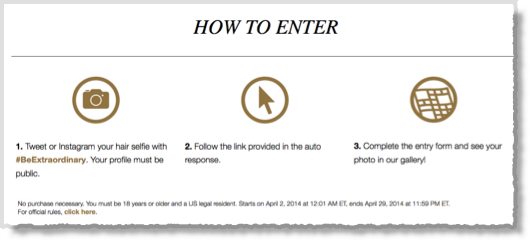
The first ingredient of a successful social website is a highly motivated audience. Just like Facebook or Instagram only work if people are motivated to snap and share photo or write status updates, a social website only works if the customer base of a brand is willing to participate. Use social media to drive customers to your website. Give them friendly tips on what makes a great selfie submission.
\
User Generated Content

Use email newsletters to advertise your new social capabilities. Build excitement by giving your customers prizes and giveaways as incentives to interact with you online. And consider ways to convince customers to draw their friends into the conversation as well, through campaigns that reward referrals. 

Step 2: Unlock “User Generated Content”
Once you build an engaged audience, you want to turn these website viewers into content producers. Your customers have the photos, videos and reviews that can powerfully influence fellow customers. But getting them to contribute content can be tricky. Start off by offering incentives. They don’t have to be prizes; consider choosing content-contributing consumers to feature in email newsletters or pick the customer with the best photo submission as your new fashion cover model. Incentives that tie into the brand message reinforce the marketing strategy. Pick an incentive that you know will mobilize your customer base and watch the content roll in.

Be sure to use a marketing software platform that has a simple and easy way for customers to authorize the photos submission for other uses. This steers you away from the legal landmines of using social content for other marketing purposes without permission, unlocking the full potential of user-generated photos and video.
User Generated Content
Step 3: Ask for submissions by hashtag
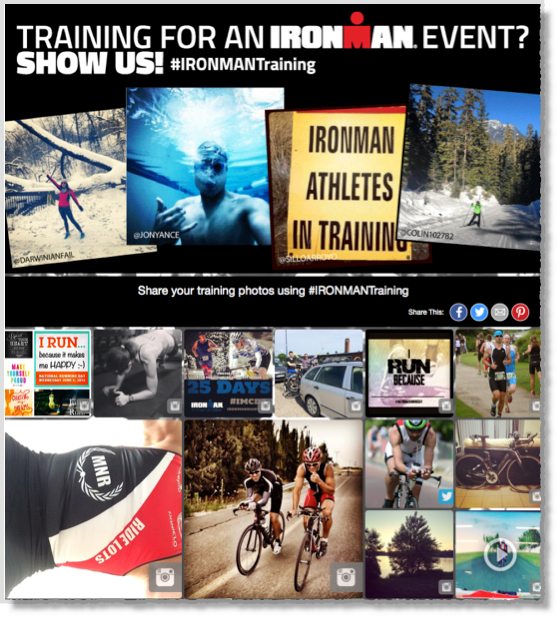
Use social media as a content funnel that is activated by hashtag. Ironman used the hashtag #IRONMANTraining to get race participants to share photos of their training swims, runs and rides.

User Generated Content
Using a hashtag, brands can pull together content submissions from across multiple social networks, including Instagram, Facebook or Twitter. The hashtag is both a mechanism for content submissions, and a way for brands to expand their social media footprint at the same time.

Some tips to effective hashtag use:
·         Promote the campaign hashtag on social, through email blasts and on your website.
·         Set a deadline
·         Advertise the prize to build momentum.

 Step 4:  Turn customers into models
As the banner ad fades and staged, contrived photography loses its punch, user-generated content is being asked to fill in as a powerful brand image source. Imagine browsing a fashion retailer’s website and instead of seeing a bunch of posed models, coming across real photos of real people wearing a brand’s clothing in real-world situations.

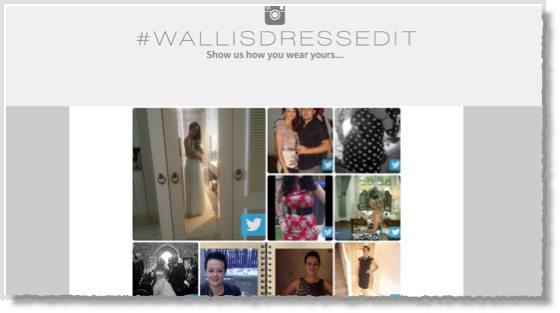
UK and Ireland fashion retailer Wallis gathered customer photos through a “#WallisDressedIt” campaign. The campaign inspired social media users to submit high-quality photos of customers-as-models that were then showcased on the Wallis website.
User Generated Content
Brands get value out of this arrangement in two ways. Their website becomes much more authentic and relatable, and brands can save big on the pricetag for photo shoots and video production.

As an added bonus, the consistent use of user-generated content brings brands and consumers closer together in a two-way relationship that makes customers feel like they are a participating part of a brand’s marketing strategy.

Step 5: Re-use customer photos
User-generated content is versatile, and companies should maximize the impact of their customer’s best work by using high-quality photos in as many ways as possible.
Try for a user-generated grand slam by seeing if photos submitted on social can be used on the website, in email newsletters, on marketing collateral and in social advertising.

Some brands are taking the use of UGC one step further by suggesting eCommerce products alongside customer photos, giving website visitors a chance to click through and purchase the items they see their friends, acquaintances or fellow customers wearing.

SoccerPro used photos submitted through their #SoccerPride photo campaign to generate eCommerce suggestions from their online stores. Customers can browse fellow soccer fans photos on SoccerPro.com, and see clickable product suggestions right alongside the user-generated content.
User Generated Content
Just like social media unlocked the power of millions of everyday citizens to become published writers photographers and videographers, social capabilities on corporate websites will turn consumers into content marketers. The brands that tap into this powerful user-generated content and leverage it to influence a new generation of savvy consumers will reap the rewards of sales driven by consumer content.

Guest author: Colleen Horan is director of product marketing at Offerpop, a digital marketing software company that helps audiences connect with brands.

Saturday, 14 June 2014

3 WAYS TO USE LINKEDIN TO GROW YOUR BUSINESS

Three FingersWhen I first started using LinkedIn back in 2011, I had just sold my previous business (door to door sales company) and moved back to Sydney to pursue my passion of becoming a business mentor.
By this stage in my business career, I had started over 6 businesses, four of which were complete failures (or should I say lessons) and two that I managed to successfully exit.
I thought this would be a perfect recipe for advising other business owners what to do and more importantly what not to do. As I started growing my business, I noticed more and more how the business landscape has changed.
The strategies I had used in the past few years to build my previous businesses were no longer as effective as they used to be. I found I was wasting a lot of time and money on:
  • Telemarketing campaigns
  • Radio advertising
  • Direct Mail
  • Attending networking functions
And the list goes on……..
Around about this time there was huge buzz around social media. Like most people I was very skeptical and maybe a little cynical. Back than it was estimated that around about 1.5 billion people used social media in their daily routine.
Logically it would seem that tapping into even a portion of those users would translate to more contacts and bigger sales revenue, so marketing specialists were urging businesses to jump into using social media for marketing and gaining brand recognition.
However, a lot of companies were still trying to get their head around it all and struggling to generate a good return on investment
Long story short I decided to look further into it and the more I found/studied those who were achieving some phenomenal results, the more excited I got about the possibilities. Some of these guys were adding $100k, $200k and even $300k to their bottom line!!
I spent the next 6-12 months studying social media to really discover which platform would work for my business and out of all the social media tools (god knows I tried all of them), there are 3 main reasons why I choose LinkedIn:

1) MEDIA

indexIn today’s business world I think consumers buy more into people than they do in companies and products. Sure having a good company reputation is important and you have to have a great product/service but all of this can quickly become irrelevant if they don’t like the people behind the company.
This is why personal branding and online reputation is important. One great way to build your reputation and expertise in the market place is ‘Media Exposure” When I first started my advisory firm I found it difficulty to stand out in the market place. It seemed like every person on a street corner was now a business coach with 99.9999999% of them with no business experience.
Crazy right?
I knew that the only way I was going to stand out in the market place was to create a unique point of difference. A week later whilst driving home from the office I read an article which said:
“LinkedIn is the number one preferred professional network for journalist and editors with over 94.2% of them being on the platform”
This got me excited, so the very next day I started connecting with journalist and what started off as a connection hear and there quickly eventuated to a network of over 250 media contacts in less than 3 months.
I than spent the next 3 months building a relationship with those contacts and as a result I was able to get into 50 media publications without spending a cent on PR or sending out a single press release.
Task: Think about the top 5 publications your customers are regularly reading and start connecting and building relationships with journalist and editors within those media outlets.
Another way you can use LinkedIn to grow your business is through:

2) JOINT VENTURE PARTNERSHIPS

indexWhether you’re launching a new business or extending a product or service in your existing business, one of the toughest and most immediate priorities is finding new clients, but often you don’t have large marketing budgets or you simply don’t have the time to spend developing new customers.
So how will you find hundreds or thousands of qualified eager customers ready to start buying your products or services straight away, and how can you do this with very little time, money or effort on your behalf?
One of the most powerful and cost effective ways to market your business to potential buyers in the marketplace. Let’s face it the sales cycle is a lot longer today than it used to be 5-10 years ago. Why waste time and precious resources developing this trust when you can partner with someone else who has already established this trust.
Task: Answer  the following two questions and than start searching, finding, connecting and developing a win-win deal with each and everyone of those partners you connect with
1)   Where are your clients going before, during and after purchasing your service/product?
2)   What companies out there already have access to this list?
Why chase after one client when you can partner with a complimentary business who has already established trust and rapport with hundreds if not thousands of your target market. Using this strategy alone through LinkedIn, Using this strategy alone I managed to establish 16 partnerships with accounting firms growing my previous business by over 328%.
And finally I’ve left the best for last:

3) 1:1 CLIENTS

1-on-1I have this fundamental belief that in business regardless of what product or service you sell, ultimately we are all in the business of Marketing with the sole objective of getting our message in front of key decision makers.
I also believe that marketing is 10% what you say, 90% how you say it. Therefore it’s hard to stand out if your marketing your business like every other competitor in your industry.
Last time I checked that’s the meaning of insanity: Doing the same thing over and over again expecting a difference result.
Why spend thousands of dollars marketing your business using traditional marketing methods when you can access a network of 300 million people, especially as 49% of them are key decision makers.
Task: Write down your marketing objectives over the next 6-12 months, get really clear in terms of who you need to connect with to achieve those objectives and than start searching, finding, connecting and building your funnel of potential leads.

Thursday, 12 June 2014

How to Become a Millionaire by Age 30


Getting rich and becoming a millionaire is a taboo topic. Saying it can be done by the age of 30 seems like a fantasy.
It shouldn’t be taboo and it is possible. At the age of 21, I got out of college, broke and in debt, and by the time I was 30, I was a millionaire.
Here are the 10 steps that will guarantee you will become a millionaire by 30.
1. Follow the money. In today’s economic environment you cannot save your way to millionaire status. The first step is to focus on increasing your income in increments and repeating that. My income was $3,000 a month and nine years later it was $20,000 a month. Start following the money and it will force you to control revenue and see opportunities.
2. Don’t show off -- show up! I didn’t buy my first luxury watch or car until my businesses and investments were producing multiple secure flows of income. I was still driving a Toyota Camry when I had become a millionaire. Be known for your work ethic, not the trinkets that you buy.
3. Save to invest, don’t save to save. The only reason to save money is to invest it.  Put your saved money into secured, sacred (untouchable) accounts. Never use these accounts for anything, not even an emergency. This will force you to continue to follow step one (increase income). To this day, at least twice a year, I am broke because I always invest my surpluses into ventures I cannot access.
4. Avoid debt that doesn’t pay you. Make it a rule that you never use debt that won’t make you money. I borrowed money for a car only because I knew it could increase my income. Rich people use debt to leverage investments and grow cash flows. Poor people use debt to buy things that make rich people richer.
5. Treat money like a jealous lover. Millions wish for financial freedom, but only those that make it a priority have millions. To get rich and stay rich you will have to make it a priority. Money is like a jealous lover. Ignore it and it will ignore you, or worse, it will leave you for someone who makes it a priority.
6. Money doesn’t sleep. Money doesn’t know about clocks, schedules or holidays, and you shouldn’t either. Money loves people that have a great work ethic. When I was 26 years old, I was in retail and the store I worked at closed at 7 p.m. Most times you could find me there at 11 p.m. making an extra sale. Never try to be the smartest or luckiest person -- just make sure you outwork everyone.
7. Poor makes no sense. I have been poor, and it sucks. I have had just enough and that sucks almost as bad. Eliminate any and all ideas that being poor is somehow OK. Bill Gates has said, "If you’re born poor, it’s not your mistake. But if you die poor, it is your mistake."
8. Get a millionaire mentor. Most of us were brought up middle class or poor and then hold ourselves to the limits and ideas of that group. I have been studying millionaires to duplicate what they did. Get your own personal millionaire mentor and study them. Most rich people are extremely generous with their knowledge and their resources.
9. Get your money to do the heavy lifting. Investing is the Holy Grail in becoming a millionaire and you should make more money off your investments than your work. If you don’t have surplus money you won’t make investments. The second company I started required a $50,000 investment. That company has paid me back that $50,000 every month for the last 10 years. My third investment was in real estate, where I started with $350,000, a large part of my net worth at the time. I still own that property today and it continues to provide me with income. Investing is the only reason to do the other steps, and your money must work for you and do your heavy lifting.
10. Shoot for $10 million, not $1 million. The single biggest financial mistake I’ve made was not thinking big enough. I encourage you to go for more than a million. There is no shortage of money on this planet, only a shortage of people thinking big enough.
Apply these 10 steps and they will make you rich. Steer clear of people that suggest your financial dreams are born of greed. Avoid get-rich-quick schemes, be ethical, never give up, and once you make it, be willing to help others get there too.

Read More At Entrepreneur

Tuesday, 10 June 2014

9 Time Saving Writing Tools for Content Marketers

9 Online Tools for More Effective Writing for Content Marketers
Have you ever had an awesome idea in your head, but didn’t find the time, discipline or will to execute it into writing?
All social writers struggle with the same problem – they are hit by inspiration in the weirdest moments, but the great ideas evaporate by the time they get to their computers and try to start writing.
The solution to that issue comes as a combination of tools that are both accessible and portable. If you start using the best tools for social writers, you will never be caught off guard again. These tools will not only provide you with a way to write down your ideas whenever they hit you, but will also enable you to organize your time better and start writing more content through a regular routine.

The best writing tools for social writers

You don’t need many resources and tools to get your creativity out on paper. However, the right tools can boost your effectiveness by providing you with a distraction-free environment, as well as the writing assistance you need. The following selection of websites, apps, and tools will make you fall in love with your profession all over again.
Here are some time saving tools for content marketers.

1. Write or Die

Possibly the most popular writing tool currently available, Write or Die is a must in every social media writer’s toolbox. If you easily get distracted by important updates on social media, then this tool will immediately bring you back to work.
9 Online Tools for More Effective Writing for Content Marketers
You don’t have to choose the Kamikaze mode right from the start, since it will be painful to watch your work getting deleted if you fail to write effectively. However, it is definitely recommended to give yourself higher goals and stricter consequences as you start getting used to Write or Die.

2. Quabel

Among all online tools that are aimed at limited your distractions, Quabel is possibly the cleanest and most effective one.
9 Online Tools for More Effective Writing for Content Marketers
By going back to the writing basics, you will be left alone with your thoughts, so the expression will become flawless. This online text editor will allow you to write without being distracted by unnecessary buttons and features.

3. NinjaEssays

If you have a very important deadline to meet, but find yourself in the middle of a writer’s block, then it’s time to get the big guns out. NinjaEssays is the coolest writing help site that puts professional writers at your disposal. You can get assistance on any type of content by talented writers who never seem to get out of ideas.
9 Online Tools for More Effective Writing for Content Marketers
The extensive team includes experts from various fields of study, so you can also rely on their assistance if you have to complete a project whose topic you don’t understand. That will save you from a huge amount of research.

4. Plotbot

Plotbot is an online editor that will format your writings automatically according to the widely-accepted standards.
9 Online Tools for More Effective Writing for Content Marketers
Although the software has been developed to serve for editing screenplays, it can also serve as an essential tool for social media writers who cannot focus unless their pages are perfectly organized.

The coolest organizational tools for social writers

You can be the most talented social media writer in the world, but you could never reach your full potential without proper organization. If you don’t manage your time effectively and organize your ideas into a steady workflow, both you and your readers will end up frustrated by your publishing schedule.

5. Wridea

If there is such thing as an effective idea management service, then Writea is the one.
9 Online Tools for More Effective Writing for Content Marketers
This website provides you with a great choice of brainstorming tools that will help you get ideas from the hidden folders of your brain. It takes only seconds to create new idea entries, and you can later update their details as a new wave of creativity attacks you.
We are listing this concept under organizational tools because it enables you to categorize your ideas under convenient groups, so you will track them easily whenever you want to.

6. Cherrytree

This tool is labeled as a “hierarchical note-taking app”.
9 Online Tools for More Effective Writing for Content Marketers
However, its functions go beyond that simple explanation, since cherytree provides a great spell check, syntax highlighting, rich text, list handling, and many other features you will find useful. This tool can serve as your personal notebook, with the important difference of better organization and management.

7. Bubbl.us

If you have never tried a mind-mapping tool, then you should start exploring that concept with bubbl.us.
9 Online Tools for More Effective Writing for Content Marketers
At this website, you can do some effective brainstorming and mind-mapping without the need of getting use to complicated options. The interface features an intuitive drag-and-drop mode that will help you keep pace with the emergence of new ideas.
You can easily save and share the mind maps, but you can also collaborate with other users on the same mind map.

The most effective productivity tools for social writers

Since you chose to be a social writer, then you are undoubtedly talented in developing content.
However, that doesn’t mean that you can always stay as productive as you want to be. There are days when you cannot keep up with the responsibilities and wish to take some time off everything. Don’t do that before trying some of the following productivity tools that can bring you back on track.

8. StayFocusd

If you want to fight online distractions, then StayFocusd should be the first weapon in your arsenal. This website blocker will save you from a lot of regret, since it won’t allow you to access distracting website during an active working session.
9 Online Tools for More Effective Writing for Content Marketers
If you prefer Firefox over Chrome (StayFocused is a Chrome extension), then you should try LeechBlock, which works in a similar manner.

9. Tomato.es

You have surely heard about the Pomodoro Technique, but did you try using it? Those writers who haven’t tried it may claim that it’s ridiculous, but its effectiveness has been proven many times before.
9 Online Tools for More Effective Writing for Content Marketers
Tomato.es is an effective Pomodoro timer that will help you reach your highest levels of productivity.

Every social writer can become better and faster!

No matter how devoted you are to your career as a social media writer, there is always more space for growth. Start exploring some of the resources we listed above and you will be much more satisfied with your achievements. If you find the right tools for your writing style, you will be able to produce better content in larger quantities without wasting any second of your working time.

Find the Original Article Here